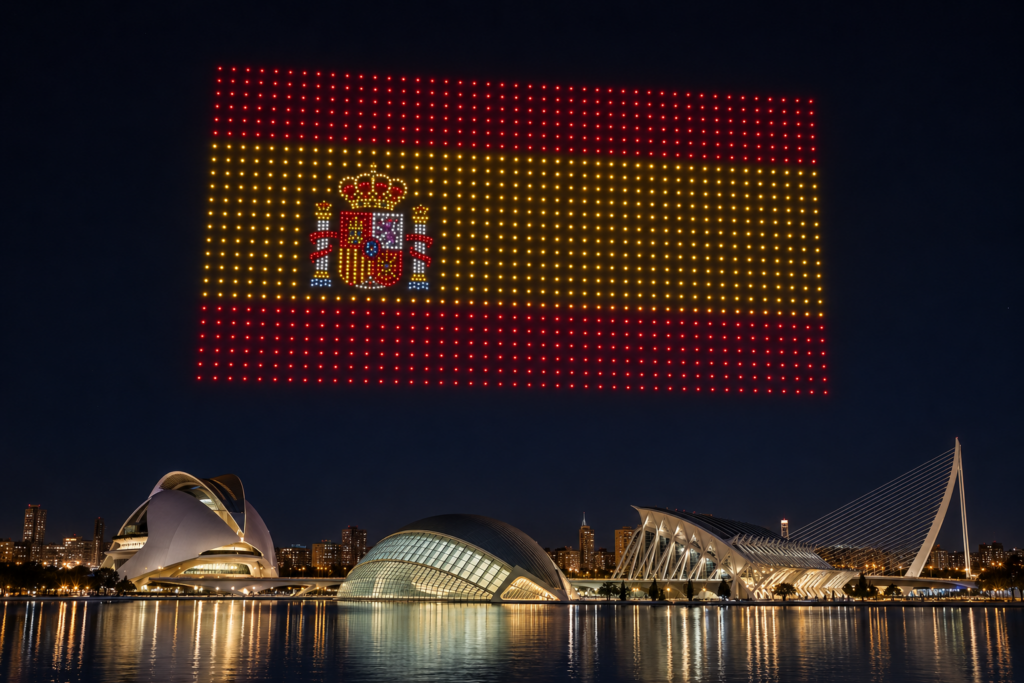
A drone show in Spain can give a festival, destination campaign or product launch a shared visual finale: hundreds of illuminated aircraft forming a story above an agreed performance area. Successful planning combines a suitable venue, a clear creative brief and the applicable AESA operating, airspace and public-display requirements. A company’s EU authorization alone does not approve a particular Spanish event.
Why the format makes sense for Spanish events

Spanish organizers already have examples of drone storytelling within public cultural programmes. Barcelona’s Institute of Culture announced Onírica, a 500-drone production for La Mercè 2025, using imagery inspired by the city’s places, stories and traditions. This is an independent event example, not a Skydance production. It shows the creative opportunity: a show can communicate a place through its visual language rather than relying on a generic finale.
For a tourism board, that might mean a short sequence connecting a local landmark, an activity and a destination identity. For a corporate launch, it might mean revealing a product silhouette before a logo. For a music festival, the priority could be a scene that resolves with the final track. The most useful starting question is what the audience should remember the next morning.
Choose the audience before choosing the skyline
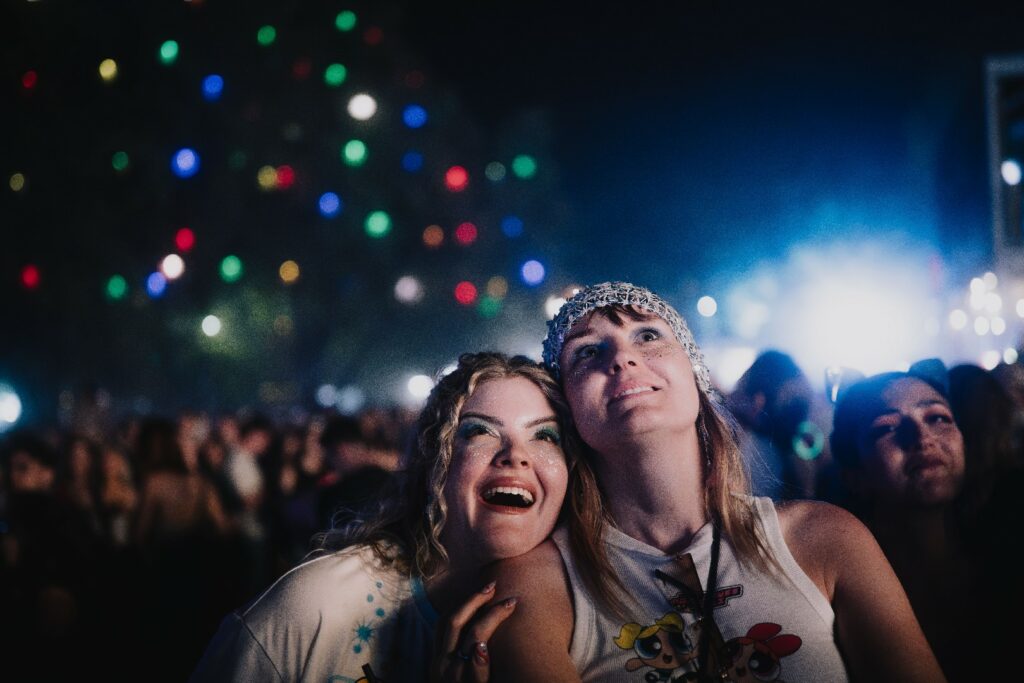
Barcelona, Madrid, Valencia, Málaga and the Balearic Islands are useful starting points for event enquiries, but a city name says little about whether a specific launch site is workable. The attractive view and the usable flight area may be in different places. Identify the principal audience position, then look for a controllable operating area with the right viewing direction.
- City festivals: develop a scene around a local story, while checking roads, surrounding buildings, audience movement and nearby aviation activity.
- Coastal destinations: consider an offshore visual backdrop only after evaluating vessel movements, beach access, recovery arrangements and coastal wind.
- Resorts and private celebrations: assess neighboring properties and public access routes as carefully as the event’s own grounds.
- Brands and sports events: plan the camera position alongside the spectator view so the main image is recognizable in both formats.
These are planning options, not approved venues. An early feasibility review is particularly useful before promising an exact skyline in an invitation or advertising campaign.
Which permissions does a drone show in Spain need

The relevant national aviation authority is the Agencia Estatal de Seguridad Aérea, usually called AESA. Drone operations follow the EU risk-based framework. A professional outdoor swarm should be assessed against the actual operation, including simultaneous aircraft, night operation, containment and spectators. Where the operation needs specific-category authorization, the authorization must cover that activity; a recreational pilot certificate is not an event approval. AESA explains the available routes in its specific-category guidance.
For an operator registered in another EU state, the applicable cross-border procedure depends on the operating basis. For operations under an operational authorization, AESA provides a process for obtaining confirmation of acceptability, including compliance with local conditions. The separate declaration and LUC routes have their own conditions; they should not be treated as interchangeable shortcuts. See AESA’s guide for foreign operators.
Spain also has an air-demonstration layer. AESA’s airshows and UAS events guidance explains the scope of Royal Decree 1919/2009, amended by Royal Decree 517/2024. For displays within its scope, the organizer submits the required responsible declaration, while the demonstration manager coordinates the necessary airspace arrangements. The guidance identifies exclusions and insurance obligations, so the event must be classified correctly rather than assuming every gathering follows the same process.
Finally, check the exact coordinates and current geographical zones using the official ENAIRE UAS information and ENAIRE Drones service. Any landowner, municipal, coastal or protected-area requirements also need to be resolved where applicable. A map check helps identify restrictions; it does not itself authorize a swarm.
Give each party a clear responsibility
Planning question | What should be agreed |
Who operates the aircraft | The named operator and the authorization covering the proposed show |
Who organizes the public display | Responsibility for the applicable event declaration and local event arrangements |
Who controls the ground | Land access, barriers, stewards, public routes and emergency access |
Who controls the programme | Music cues, darkness, weather decisions and any delay window |
This simple division prevents an event team from assuming the venue has handled an aviation task, or an operator from assuming a public path will be closed. Record the agreed responsibilities in the production brief.
Build the creative brief around the real performance window
Confirm sunset and usable darkness for the event’s date and coordinates before assigning a show cue. A summer programme may need to place the drone sequence later than an indoor audience would expect. Balance that timing with the concert schedule, transport departures, local event conditions and the needs of families attending.
A useful Spanish destination concept could begin with an abstract wave, develop into a recognizable local architectural outline and close with the destination name or flag. Treat it as a creative proposal that must be adapted to local context and permissions. Avoid squeezing too many landmarks into one short sequence: fewer well-resolved images give spectators time to recognize, photograph and remember them.
Specify a separate media brief: the principal filming position, required landscape and portrait clips, image rights and intended campaign use. Any filming drone is an additional aircraft operation and must be coordinated with the show. Strong footage is a production outcome to plan, not a promise of automatic viral reach.
Questions organizers ask about drone shows in Spain
Can a drone show take place over the audience?
Do not design the event around crowd overflight. Start with a controlled show area separated from spectators and let the operator determine the required buffers through its authorization and risk assessment. The right separation depends on the aircraft, performance volume and site; there is no universal event distance to copy.
Does a Spanish event need both drone and airshow paperwork?
It can. AESA distinguishes the drone operation from requirements for air demonstrations within the national rules’ scope. Confirm the event classification and responsibilities before contracting. An accepted flight authorization does not remove applicable organizer obligations.
Can a beach or harbor make approval easier?
Open views can improve visibility, but water does not automatically create a controlled area. Boats, swimmers, protected areas and nearby aviation may add constraints. Request a site assessment before using the coastline as the central selling point.
How much does a drone show in Spain cost?
The quotation depends on the number of drones, scene complexity, travel, site preparation, permissions, performance dates and content capture. Compare suppliers against the same storyboard and scope. A headline fleet size alone does not describe the work or the finished result.
Plan your drone show in Spain with Skydance
Skydance is a Slovenia-based drone show provider offering creative development and show production. Explore our drone show services, then send us your Spanish event brief: date, precise location, audience position, event purpose and budget range. We can discuss the concept and feasibility before you commit to a final design or announce a specific aerial spectacle.